The AI EU Rulebook Seen as a Moat
 automatically translated from French
We often hear, on the other side of the Atlantic, a recurring criticism: "Europe is shooting itself in the foot with its AI EU Rulebook. Too heavy, too complex, too soon."
Yet mastering the rules of the game in the world’s second-largest economic power offers a genuine competitive advantage—provided our industries stop viewing the “regulatory mille-feuille” (AI Act, Data Act, CRA, PLD) as a brake. On the contrary, it is the opportunity to build what Warren Buffett defines as the essential attribute of a lasting business:
"A truly great business must have an enduring 'moat' that protects excellent returns on invested capital."
What if we treated regulation as a market structure? What if we turned compliance into a structural competitive advantage and an impassable defensive moat?
In critical systems (Healthcare, Industry, Finance), AI adoption will not be driven by the promise of “magic,” but by the guarantee of robustness. By imposing high standards on “High-Risk” systems, the AI Act creates a ruthless market filter. What looks like a constraint is in reality the promise of “Deutsche Qualität.” Where “light-tech” players see a wall, industrial players must see a paved road. So instead of avoiding “High-Risk” use cases, target them. That is where the trust premium lies. Sell “Enterprise-Grade” solutions that non-compliant startups will never be able to offer to major accounts.
The GDPR + AI Act pairing forces the emergence of sovereign architectures, but it is the Data Act that truly reshuffles the value cards. It marks the legal end of manufacturers’ monopoly on IoT data. Proprietary data “silos” are now legally dismantled. We finally have the tools to demand access to operational field data—the place where real value is created. Shift from defensive to offensive. Create value-added services (predictive maintenance, optimisation) based on data from your competitors’ or partners’ equipment.
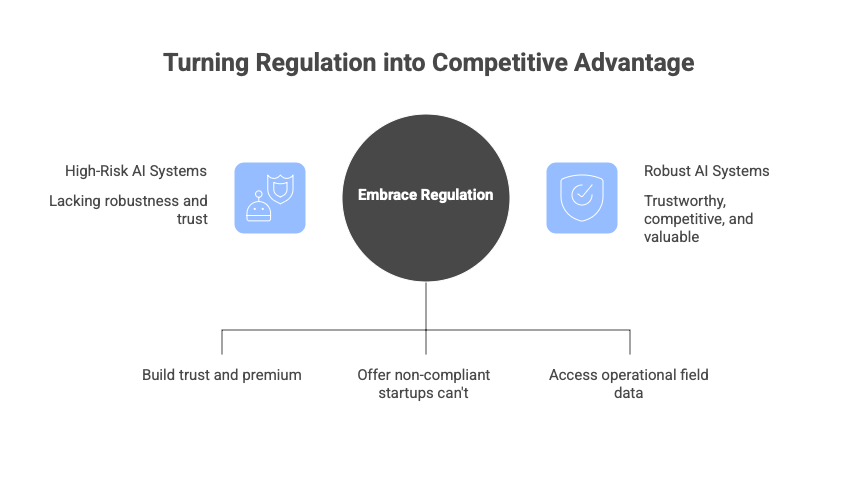
The trap would be to handle compliance with a “legal Excel spreadsheet.” We must industrialise this governance at the very core of the technology stack (DevSecMLOps/LLMOps). When the new Product Liability Directive introduces a presumption of causality, we must put safeguards in place to prove that our AI has undergone an exhaustive battery of tests—because the burden of proof now lies with the manufacturer.
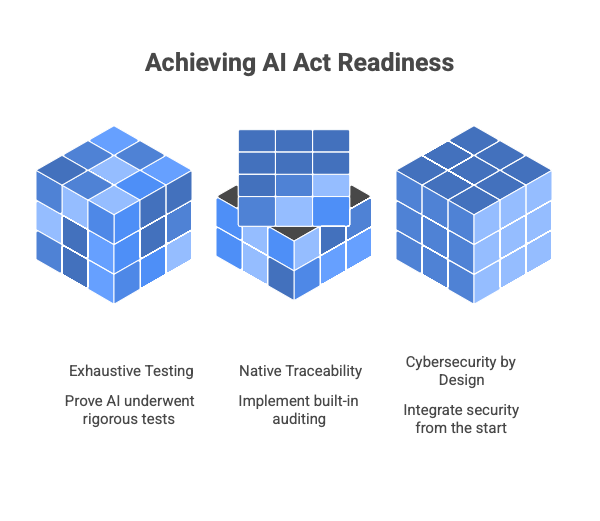
The “Move fast and break things” model has become suicidal. Your software factories must become “proof generators.” Native traceability, cybersecurity by design, built-in auditing. Those who embed these building blocks today will sell “AI Act Ready” solutions tomorrow.
Faced with this landscape, two winning postures emerge depending on your size. The era of artistic vagueness is over:
-
For Large Groups – the “Fortress” strategy: use regulatory complexity as a barrier to entry. By turning compliance into an industrial standard, you make the market inaccessible to new entrants who lack your quality processes. You no longer sell AI—you sell legal security.
-
For Startups & SMEs – the “Speedboat” strategy: don’t try to build the moat (it’s too expensive). Instead, navigate with agility by slightly tweaking a feature to exit the “High-Risk” classification, and arrive with a ready-to-use “Trust Pack” (turnkey compliance) to become a “zero-risk” supplier.
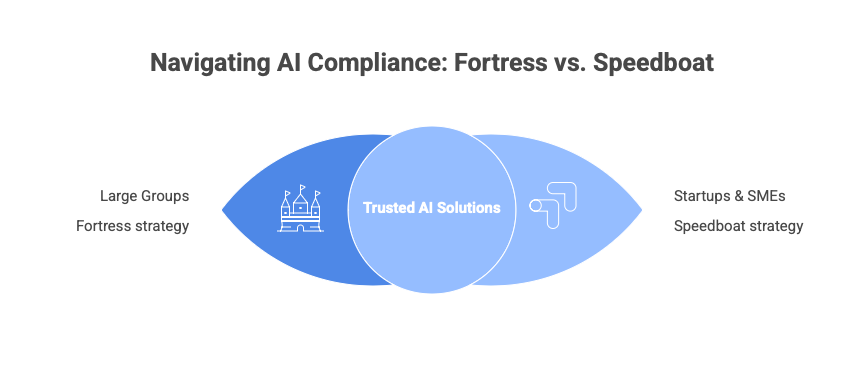
Europe is not simply asking us to “respect the rules.” It is giving us the opportunity to define the global standard for industrial AI. It is time to move from a defensive compliance posture to an offensive value-creation strategy. Complexity, once mastered, is your best Moat.
We have the advantage of being on the European market, closest to the institutions that created these rules. On our own soil we are all playing by the same handbook, while other countries that must comply with our rules are clearly at a disadvantage. Let’s seize it!
The opinions expressed in this article are strictly personal and do not necessarily reflect those of my employer. The content is provided for information purposes only and does not constitute legal advice.